Fifteen Times a Second: The Brain's Hidden Vote on What You See
For decades, research on consciousness in the brain looked for a place. A new preprint from Doris Tsao's lab at UC Berkeley adds timing as a second variable. When two faces compete for your attention and you see only one, face neurons switch between a clean copy of the seen face and a clean copy of the unseen face. In two monkeys, the switch happened about 15 times a second.
What did the study do?
The paper is Rapid alternation of conscious and suppressed stimulus representations in the primate brain, by Janis Hesse, Frank Lanfranchi, Conor McGrory, Yuelin Shi, Tatiana Engel and Doris Tsao. It is on bioRxiv and has not passed peer review yet. I first read about it in an OfficeChai summary. Psychreg also covered it.
The researchers used a trick called binocular flash suppression. It holds the image on the retina fixed and changes what you see. One face goes to one eye. Then a different face flashes to the other eye. The new face replaces the first face in your vision, and the first face disappears from awareness even though it is still on the screen and still on your retina.
The team first tested the trick on 14 human volunteers, who almost always reported that they saw the new face. Then two rhesus macaques watched the same displays while Neuropixels probes recorded hundreds of neurons at once. The probes sat in two face-processing areas of the temporal lobe and two areas of the prefrontal cortex. The monkeys saw 1,500 different faces.
What did it find?
Averaged over seconds, the neurons looked only weakly affected by which face the animal saw. Earlier studies found the same weak effect. The researchers then looked at the activity in windows of about 10 milliseconds, and the weak effect split into two strong states:
| State | What the neurons encode | Duration |
|---|---|---|
| Seen | The face that reaches awareness. The researchers could rebuild a recognizable image of it from the activity. | About 60 ms |
| Unseen | The suppressed face, also clear enough to rebuild as an image | About 60 ms |
The two states alternate about 15 times a second. The same neurons carry both faces in turn. The brain does not use separate groups of cells for the seen face and the unseen face. The researchers used one random half of the neurons to label each moment as seen or unseen, and the other half to rebuild the face. This split prevents a circular result, and the two states still appeared. The prefrontal recordings showed a similar pattern with more noise.
Decades of binocular rivalry studies found only a weak signal for conscious perception. The authors argue that this weak signal was the average of two strong and opposite signals. The older analyses averaged over seconds, so they mixed the two signals.
What does the fine print say?
The headlines say that consciousness is not a place in the brain. The data supports a narrower claim. Psychreg lists the limits:
- The neural recordings come from two monkeys.
- The monkeys did not report what they saw. The researchers inferred the monkeys' perception from the human volunteers.
- The two states are not mirror images. Tuning to the seen face was about a fifth stronger than tuning to the unseen face.
- A simple decoder classified the two states correctly 66% of the time. Chance is 50%.
- The switches were only loosely coordinated between neighboring face areas.
- The study shows that the switches occur at the same time as perception. It does not show that the switches cause perception.
The switches also happened in specific places: face areas and prefrontal cortex. Location still matters in this study, and timing is a second variable next to it. The large COGITATE collaboration tested two rival theories of where consciousness happens in the brain in 2025 and could not settle the question. A timing signal like this one gives the next test something new to measure.
Where does the unseen face go?
The authors state that they do not know yet why the brain selects some of those 60-millisecond windows for awareness and not the rest. Their guess is that the brain uses the unseen windows to test other readings of the scene in the background. The seen windows may carry whichever reading the brain sends to memory, decisions and report.
An older study with the same trick fits that guess. In 2002, Gabriel Kreiman, Itzhak Fried and Christof Koch recorded single neurons in human patients during the same flash suppression trick. The patients had electrodes for epilepsy treatment. About two thirds of the visually selective neurons in the medial temporal lobe followed the face that the patient saw. None of them responded to the suppressed face. The medial temporal lobe contains the hippocampus and other memory structures, and it receives visual signals after the face areas in the new study.
I infer that the vote may already be over by the time the signal reaches memory. The face areas still hold both candidates, and the memory areas only get the winner. This inference combines two separate studies, and the authors do not claim it.
The unseen face probably still has an effect. Psychreg notes that a rich trace of unseen images could help explain how things that you never notice can still affect your attention and mood.
Is perception a series of frames?
The idea that perception runs in steps is old. Rufin VanRullen's 2016 review, Perceptual Cycles, argues that perception is rhythmic and that several brain oscillations drive it. The new study measures a different thing from the cycles in that review. In the new study, the neurons switch between two different contents while you see one steady face.
Does a Tesla see the road the same way?
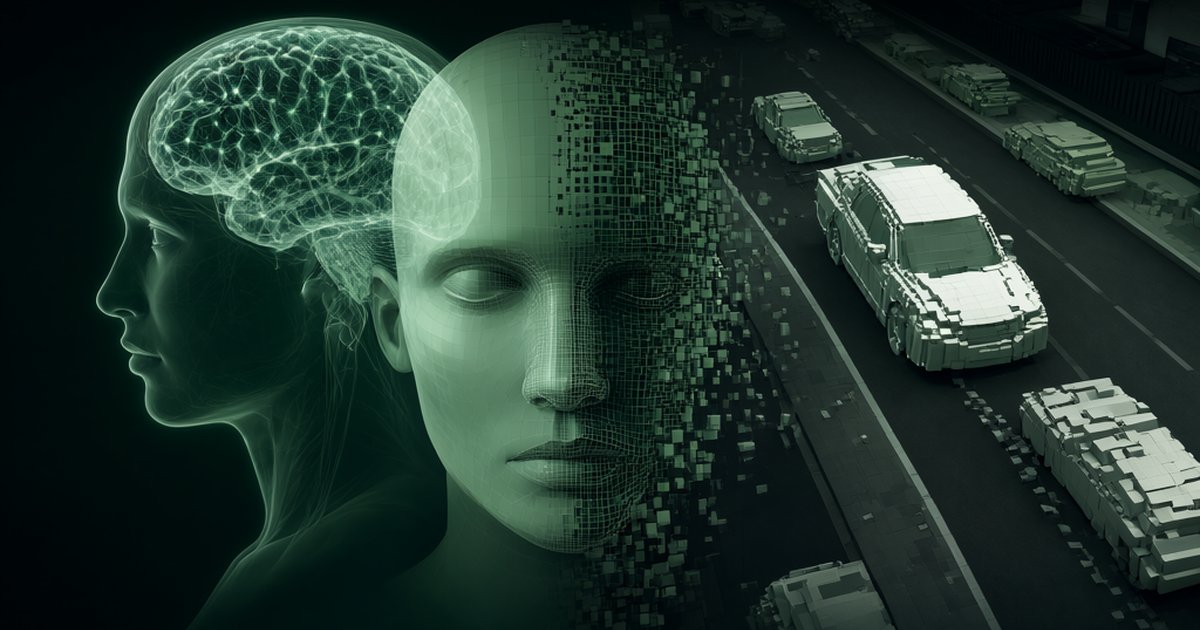
A brain and a car, each working from a model it built. AI-generated illustration.
Flash suppression already shows that experience differs from the raw input. The image on the retina stays the same, and the face that you see changes. The new study shows that what you experience matches one of two internal representations, and that the brain switches between them while the input holds still.
For the broader idea, Anil Seth calls perception a controlled hallucination. In his account, the brain predicts the causes of its sensory signals and uses the signals to correct the prediction. The blind spot is the everyday example. Each eye has a gap where the optic nerve leaves the retina, and you never see a hole, because the brain fills the gap.
Tesla's driving software works on a similar principle. At Tesla's 2021 AI Day, Andrej Karpathy described a network that fuses video from eight cameras into one 3D vector space around the car. The network keeps memory over time, so a car that a truck hides stays in the model.
A Tesla patent published in March 2026 describes the occupancy network. The network predicts whether each voxel, a small 3D cell of space around the car, holds an object. It fuses the current frame with earlier frames to estimate how the occupied voxels move. According to Not a Tesla App's summary of the patent, the same data generates the 3D map on the car's screen. The picture on that screen is a render of the model that the car built from its cameras.
Tesla now trains one end-to-end network from the cameras to the steering and speed. After his talk at ICCV 2025, Ashok Elluswamy, Tesla's VP of AI software, wrote that "the gradients flow all the way from controls to sensor inputs." A slide that leaked from the talk lists 3D occupancy and 3D Gaussian rendering among the network's outputs, next to the driving actions. The slide's title is "Interpretability and Safety Assurance." My reading of that title is that the 3D outputs also let engineers see what the network believes.
In both systems, as I see it, the parts that act and report work from a constructed model. The car's planner acts on its 3D model, and its screen shows that model to the passenger. The brain sends one of its two candidate readings to memory and report, and you experience that reading.
The parallel has limits. Tesla engineered and trained its network for one task, and nobody claims that it has experience. The switch at 15 times a second is a finding about two monkeys and one kind of image. The study shows that experience follows an internal representation. It does not show that the brain builds a full 3D world model the way the car does.
What happens in the windows you never see?
So your steady view of one face may be the result of a vote that the brain takes 15 times a second. Only the winner reaches you.
The study raises these questions for me:
Does the vote ever reverse, and would you notice?
If the brain continues to test the reading that it rejected, how often does a rejected reading win later?
When a truck hides a car from a Tesla's cameras, the hidden car stays in the Tesla's model. When something leaves your view, what does your brain keep of it in its model?
A large language model (LLM) computes a score for every possible next word and then shows you one. Does a mind that discards most of its options to stay coherent feel like an LLM from the inside?
And if most of what the brain represents never reaches you, how much of what you call yourself is the part that won?